
Most people judge their health by looking at the number on the scale. While body weight matters, it doesn’t tell you where your body stores fat. That’s an important detail because fat around your abdomen carries greater health risks than fat stored in other areas.
Imagine two people who weigh 80 kg. One carries most of their weight in their hips and legs, while the other stores more fat around the waist. Even though they weigh the same, their health risks may differ.
That’s why doctors, dietitians, and fitness professionals often measure abdominal circumference. This simple measurement helps estimate abdominal fat and monitor changes over time. It also works well alongside body mass index (BMI), body fat percentage, and waist-to-height ratio.
The best part? You can measure your abdominal circumference at home in less than five minutes. All you need is a flexible measuring tape and the right technique.
This guide explains exactly how to measure abdominal circumference, why it matters, common mistakes to avoid, and how to get accurate results every time.
What Is Abdominal Circumference?
Abdominal circumference measures the distance around your abdomen at a specific point. Many people also call it waist circumference because the measurement usually comes from the narrowest part of the waist or the midpoint between your ribs and hip bones.
Doctors use this measurement because it provides valuable information about fat distribution. Your body stores fat in different places. Some fat sits just beneath the skin, while another type surrounds internal organs. Health experts call this visceral fat.
Visceral fat deserves special attention because it can affect your heart, liver, pancreas, and other organs. High levels of visceral fat often increase the risk of several long-term health conditions.
Unlike weight, abdominal circumference focuses on where your body stores fat instead of how much you weigh. As a result, it gives healthcare professionals another useful way to evaluate your health.
Why Does Abdominal Circumference Matter?
Many people believe losing weight should be their only goal. In reality, reducing abdominal fat often matters even more.
A larger abdominal circumference may increase your risk of:
- Heart disease
- Type 2 diabetes
- High blood pressure
- High cholesterol
- Stroke
- Fatty liver disease
- Sleep apnea
- Metabolic syndrome
For example, someone may lose only 2 kilograms over several months. At first, that doesn’t sound impressive. However, if their waist shrinks by 8 centimeters, they’ve likely reduced a significant amount of abdominal fat.
That’s why fitness coaches often measure waist size along with body weight.
Healthcare professionals also use abdominal circumference to:
- Monitor weight-loss progress
- Assess obesity-related health risks
- Evaluate fitness improvements
- Track body composition changes
- Support nutrition and exercise planning
Instead of relying on one measurement, they look at several health indicators together.
What You Need Before Measuring
You don’t need expensive equipment.
Gather these simple items before you begin:
- A flexible measuring tape
- A mirror (optional)
- A notebook or phone to record your measurements
Avoid using a metal construction tape measure. It doesn’t wrap comfortably around your body and often produces inaccurate readings.
If possible, measure your abdomen first thing in the morning before breakfast. Your stomach naturally expands after eating, so morning measurements usually stay more consistent.
Wear lightweight clothing or measure directly against your skin for the best accuracy.
How to Measure Abdominal Circumference
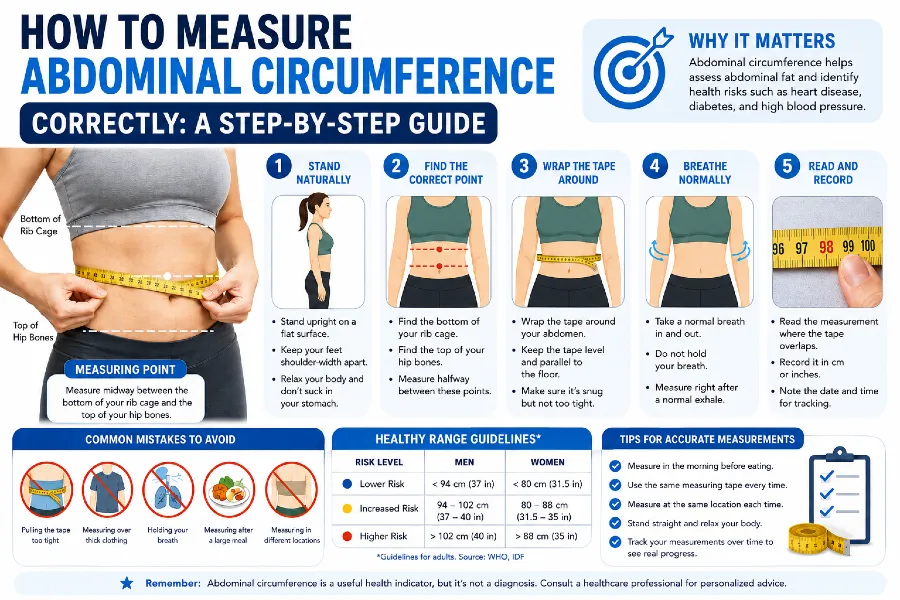
Measuring your abdominal circumference takes only a few minutes. Following the same steps each time helps you track changes more accurately.
Step 1: Stand Naturally
Stand upright on a flat surface.
Keep your feet about shoulder-width apart and let your arms rest comfortably at your sides.
Try not to tighten your stomach muscles. Many people automatically pull in their abdomen when measuring their waist. Doing so creates a smaller number that doesn’t reflect your actual measurement.
Relax and breathe normally.
Step 2: Find the Correct Measuring Point
Finding the correct location makes a big difference.
Place your fingers on the bottom of your rib cage. Next, locate the top of your hip bones.
Now imagine a line halfway between those two points. Wrap the measuring tape around your abdomen at that level.
For many people, this area sits slightly above the belly button. However, everyone’s body is different, so don’t rely on the belly button alone.
Using the same location every time gives you more reliable results.
Step 3: Wrap the Measuring Tape Around Your Waist
Place the tape around your abdomen.
Check that it:
- Stays parallel to the floor
- Lies flat against your skin
- Doesn’t twist
- Feels snug without pressing into your skin
A mirror helps you confirm that the tape stays level around your entire body.
If the tape rises in the back or dips in the front, adjust it before taking the measurement.
Step 4: Breathe Normally
Take a normal breath.
Then breathe out naturally.
Read the measurement immediately after you exhale.
Don’t hold your breath or force all the air from your lungs. Both actions can change the result.
A relaxed exhale provides the most consistent measurement.
Step 5: Record Your Measurement
Read the number where the tape overlaps.
Write the measurement in centimeters or inches.
Also record:
- The date
- The time
- Your body weight (optional)
Keeping a simple log helps you spot trends over time.
For example:
| Date | Abdominal Circumference |
|---|---|
| July 1 | 101 cm |
| July 15 | 99 cm |
| August 1 | 97 cm |
Even small improvements become easier to notice when you track your measurements regularly.
Common Mistakes That Affect Accuracy
Small mistakes can change your results by several centimeters.
Here are the most common ones.
Measuring After a Large Meal
Food and drinks temporarily expand your abdomen.
Instead, measure before breakfast or at the same time each day.
Pulling the Tape Too Tight
Some people pull the tape firmly against their skin.
This compresses body fat and produces a smaller measurement.
The tape should rest comfortably without squeezing your abdomen.
Measuring Over Thick Clothing
Sweaters, hoodies, and heavy shirts add extra bulk.
Whenever possible, measure directly against your skin.
Lightweight clothing works if necessary.
Holding Your Breath
Many people inhale deeply before measuring.
Others pull their stomach inward.
Both habits create inaccurate readings.
Instead, breathe normally and relax.
Changing the Measuring Location
One week you measure at your belly button.
The next week you measure above your waist.
Your numbers won’t be comparable.
Choose one location and use it every time.
Consistency matters more than perfection.
Tips for More Accurate Measurements
A few simple habits can improve your results.
- Measure on the same day each week.
- Use the same measuring tape every time.
- Stand in the same position.
- Measure before eating whenever possible.
- Record every measurement.
- Ask another person to help if you struggle to keep the tape level.
- Don’t compare measurements taken using different techniques.
Think of abdominal circumference as a long-term health marker rather than a daily score. Small day-to-day changes are normal. Focus on trends over weeks and months instead.
Healthy Abdominal Circumference Ranges
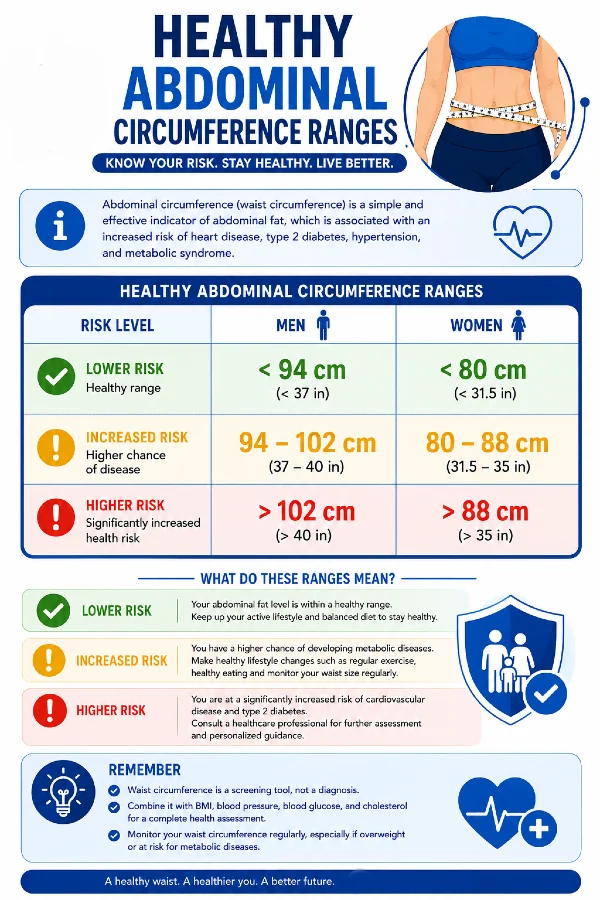
Once you know how to measure your abdominal circumference, the next step is understanding what the number means.
Healthcare organizations use waist measurements as a simple screening tool. They don’t diagnose a medical condition on their own. Instead, they help identify people who may have a higher risk of developing certain diseases.
The table below shows the general guidelines used for adults.
| Category | Men | Women |
|---|---|---|
| Lower Risk | Less than 94 cm (37 in) | Less than 80 cm (31.5 in) |
| Increased Risk | 94–102 cm (37–40 in) | 80–88 cm (31.5–35 in) |
| Higher Risk | More than 102 cm (40 in) | More than 88 cm (35 in) |
Keep in mind that these values provide general guidance. Your age, ethnicity, muscle mass, and medical history can also influence your overall health risk.
Instead of focusing on one measurement, look at your waist size together with your BMI, blood pressure, cholesterol levels, and lifestyle habits.
Abdominal Circumference vs. Waist Circumference
Many people wonder whether these measurements are different.
In most situations, they mean the same thing.
Healthcare professionals often use the terms interchangeably because both measure the distance around your midsection.
However, some organizations recommend measuring at slightly different points.
For example:
- Some measure midway between the ribs and hip bones.
- Others measure at the top of the hip bones.
- A few recommend measuring at the narrowest part of the waist.
If you measure yourself at home, the most important rule is consistency. Use the same measuring point every time so you can compare your results accurately.
Abdominal Circumference vs. BMI
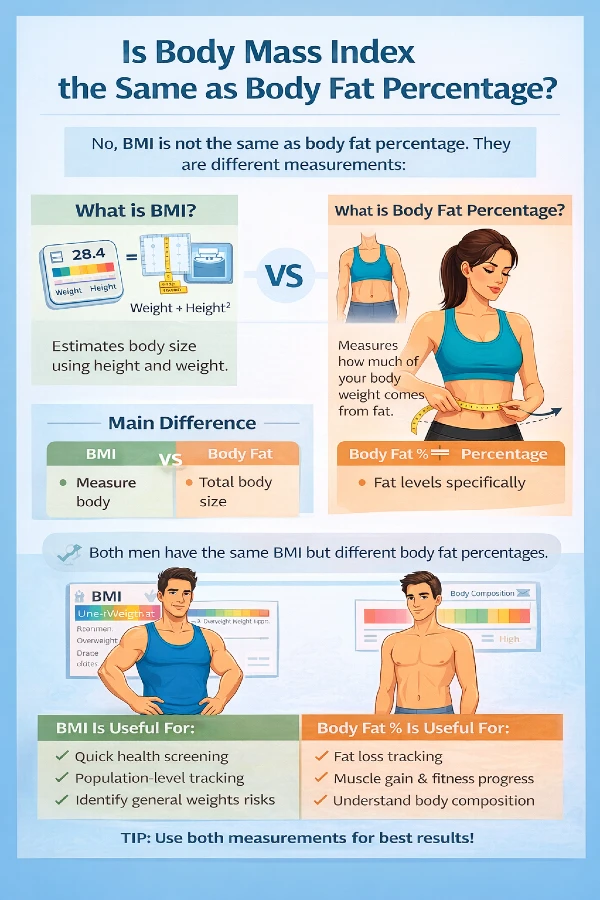
BMI and abdominal circumference both provide useful information, but they measure different things.
BMI estimates body weight based on height.
Abdominal circumference estimates fat stored around the waist.
For example, two people may have the same BMI of 27. One may carry extra weight around the hips, while the other stores most of it around the abdomen.
The second person may face a higher risk of metabolic diseases because abdominal fat surrounds important organs.
For this reason, many healthcare providers use both measurements together instead of relying on one alone.
Abdominal Circumference vs. Waist-to-Height Ratio
Another useful measurement is the waist-to-height ratio.
Instead of looking only at waist size, this method compares your waist measurement with your height.
Many experts recommend keeping your waist circumference below half of your height.
For example:
- Height: 180 cm
- Healthy waist target: Less than 90 cm
This calculation gives another way to assess body fat distribution.
If you want a more complete picture of your health, calculate your:
Using several measurements provides better insight than relying on one number alone.
How Often Should You Measure?
Daily measurements rarely provide useful information.
Your waist size can change throughout the day because of:
- Meals
- Water intake
- Exercise
- Digestion
- Bloating
Instead, follow a regular schedule.
General health:
Measure once each month.
Weight-loss journey:
Measure every two weeks.
Fitness program:
Measure every one to two weeks.
Always measure under similar conditions.
For example, measure before breakfast on the same weekday each time.
How to Reduce Your Abdominal Circumference
Reducing abdominal circumference takes time, but healthy habits make a difference.
Eat a Balanced Diet
Choose foods that keep you full and support fat loss.
Good options include:
- Lean protein
- Whole grains
- Fruits
- Vegetables
- Legumes
- Healthy fats
Limit sugary drinks, processed snacks, and foods high in added sugar.
Stay Active
Exercise helps reduce body fat and improve overall health.
Aim for at least 150 minutes of moderate exercise each week.
Good choices include:
- Walking
- Cycling
- Swimming
- Strength training
- Jogging
Even a daily walk can support long-term progress.
Sleep Well
Poor sleep can affect hunger hormones and increase cravings.
Most adults should aim for seven to nine hours of quality sleep each night.
Manage Stress
Long-term stress can contribute to weight gain around the abdomen.
Simple habits can help.
Try:
- Deep breathing
- Prayer or meditation
- Spending time outdoors
- Regular physical activity
Stay Consistent
Quick fixes rarely produce lasting results.
Small improvements repeated every day usually lead to better long-term outcomes.
Practical Example
Let’s look at a simple example.
Sarah begins a healthy eating plan and starts walking for 40 minutes every day.
On the first day:
- Weight: 82 kg
- Abdominal circumference: 98 cm
After eight weeks:
- Weight: 79 kg
- Abdominal circumference: 91 cm
Although Sarah loses only 3 kg, her waist shrinks by 7 cm.
That change suggests she has reduced abdominal fat, even though the scale shows only moderate weight loss.
This example highlights why tracking abdominal circumference can be just as important as tracking body weight.
Final Thoughts
Learning how to measure abdominal circumference is simple, but using the correct technique makes all the difference. A consistent measurement can help you monitor fat loss, assess health risks, and track your progress over time.
Remember that one measurement doesn’t define your health. Instead, combine abdominal circumference with your BMI, waist-to-height ratio, activity level, and overall lifestyle for a better understanding of your health.
If you’re tracking your fitness journey, record your waist measurement regularly and compare your results over several weeks rather than from one day to the next.
Use the Abdominal Circumference Calculator on Calculators.fit to calculate your measurement quickly and monitor your progress with confidence.
People Also Ask (PAA)
Where should I measure abdominal circumference?
Measure halfway between the bottom of your ribs and the top of your hip bones. Keep the tape level around your body and measure after a normal exhale.
Should I measure before or after eating?
Measure before eating whenever possible. Morning measurements usually provide the most consistent results.
Can I measure over my clothes?
Light clothing may work, but measuring directly against your skin gives the most accurate reading.
Is abdominal circumference better than BMI?
Neither measurement is better. Each tells you something different. Using both provides a clearer picture of your health.
Can my abdominal circumference decrease even if my weight stays the same?
Yes. You may lose body fat while gaining muscle. In that case, your waist measurement may decrease even though your weight changes very little.
Does age affect abdominal circumference?
Yes. Body composition often changes with age. However, healthy eating and regular exercise can help you maintain a healthy waist measurement.
FAQs – How to Measure Abdominal Circumference Correctly
-
Is abdominal circumference the same as waist size?
Most people use both terms interchangeably. However, some medical guidelines recommend slightly different measuring points.
-
How often should I check my abdominal circumference?
Measure every two to four weeks if you’re trying to lose fat. Monthly measurements work well for general health.
-
What is a healthy abdominal circumference for men?
Most guidelines consider less than 94 cm (37 inches) a lower-risk measurement.
-
What is a healthy abdominal circumference for women?
Most guidelines consider less than 80 cm (31.5 inches) a lower-risk measurement.
-
Can exercise reduce abdominal circumference?
Yes. Regular exercise and a healthy diet can gradually reduce abdominal fat.
-
Does drinking water affect my measurement?
Water may cause small temporary changes. Measure under the same conditions each time for consistent results.
-
Should I suck in my stomach while measuring?
No. Stand naturally and breathe normally. Pulling your stomach inward produces an inaccurate measurement.
-
Which tape measure should I use?
Use a flexible cloth or fiberglass measuring tape designed for body measurements.