
Accurate height measurement is essential for health assessments, fitness tracking, and calculations such as BMI and calorie needs. While many people measure height using tape or wall markings, these methods often lead to inconsistent results.
Stadiometers are widely used in medical and fitness settings because they are designed to measure height in a standardized way. But how accurate are they in real-world use?
Are Stadiometers Accurate? (Quick Answer)
Yes, stadiometers are highly accurate when used correctly. They are considered the standard method for measuring height in medical and professional settings because they provide consistent and precise results, usually within a few millimeters.
What Is a Stadiometer?
A stadiometer is a device specifically designed to measure a person’s height. It consists of a vertical measuring scale and a movable horizontal headpiece.
To take a measurement, a person stands upright against the device, and the headpiece is lowered to rest gently on the top of the head. The height is then read from the scale.
This setup ensures that height is measured in a straight vertical line, which reduces errors commonly seen with manual methods.
Why Stadiometers Are Used Instead of Measuring Tape
Before understanding accuracy, it is important to understand why stadiometers are preferred.
Measuring tape and wall markings depend heavily on technique. Small mistakes in alignment, posture, or reading can lead to incorrect results.
Stadiometers solve these problems by:
- Providing a fixed vertical scale
- Using a headpiece for consistent measurement
- Reducing human error
Because of this, they are widely used in clinics, gyms, and research settings.
How Accurate Are Stadiometers in Practice?
Stadiometers are capable of measuring height very precisely, often within a few millimeters. This level of accuracy makes them reliable for both medical assessments and fitness tracking.
However, accuracy does not depend only on the device. It also depends on how the measurement is taken.
If used incorrectly, even a stadiometer can give inaccurate results. This is why proper technique is essential.
What Affects the Accuracy of a Stadiometer?
Even with a high-quality device, several factors can influence the final measurement.
Posture is one of the most important factors. If a person is not standing fully upright, the measured height may be lower than actual height.
Head position also matters. Looking up or down changes the alignment of the body and can slightly affect the reading.
Time of day plays a role as well. People are usually slightly taller in the morning and shorter in the evening due to natural spinal compression.
Footwear should always be removed, as shoes add extra height.
Hair can also interfere if the headpiece rests on it instead of the scalp.
These factors do not make the device inaccurate, but they affect how accurate the measurement will be.
How to Use a Stadiometer Correctly
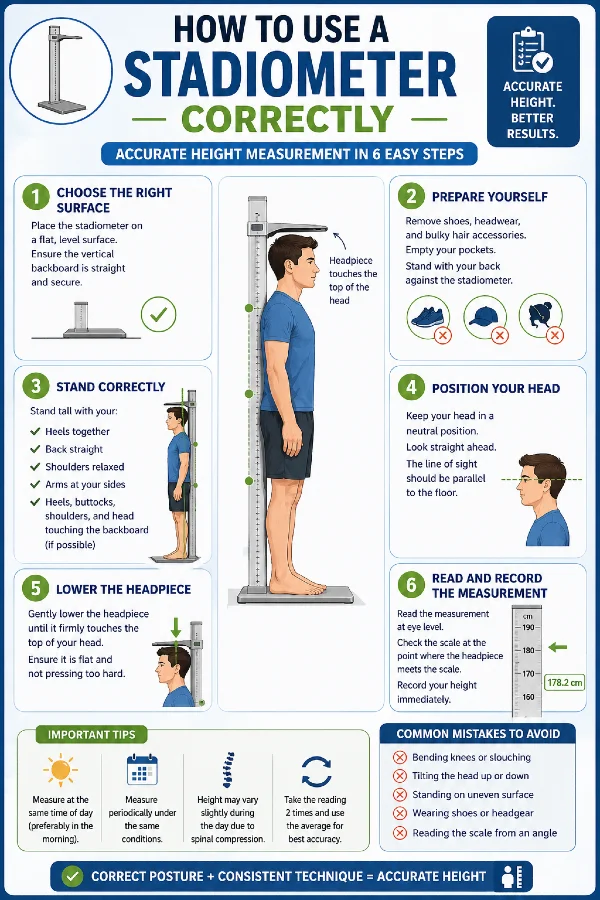
Correct usage is what ensures accuracy.
Stand straight with your heels together and your back aligned against the vertical surface. Ideally, your heels, buttocks, shoulders, and head should touch the stadiometer.
Keep your head in a neutral position and look straight ahead.
Lower the headpiece gently until it touches the top of your head. It should rest firmly but not press down.
Read the measurement at eye level to avoid reading errors.
For best results, take the measurement more than once and use consistent conditions each time.
Are Stadiometers More Accurate Than Other Methods?
Yes, stadiometers are generally more accurate than other common methods.
Measuring tape can bend or shift, which affects alignment. Wall markings depend on consistent technique and can vary each time.
A stadiometer provides a fixed and standardized way to measure height, making it more reliable.
This is especially important when height is used in calculations such as:
- BMI
- Calorie needs
- Body composition estimates
Accurate height leads to more reliable results in these calculations.
Are Home Stadiometers Reliable?
Home stadiometers can be reliable if they are used correctly.
Portable and wall-mounted versions are commonly available. When placed on a flat surface and used with proper technique, they can provide consistent results.
While professional-grade devices may be slightly more precise, home stadiometers are still more accurate than basic methods like measuring tape.
Does Height Change During the Day?
Yes, height can change slightly throughout the day.
Most people are a little taller in the morning and slightly shorter in the evening. This happens because the spine compresses during daily activities.
The difference is usually small but can affect measurements if taken at different times.
For consistency, it is best to measure height at the same time of day.
Common Mistakes That Reduce Accuracy
Many measurement errors come from simple mistakes rather than the device itself.
Standing with feet apart instead of together can slightly increase measured height.
Leaning or slouching reduces height.
Tilting the head upward or downward affects alignment.
Reading the measurement from an angle can lead to incorrect values.
Avoiding these mistakes improves accuracy significantly.
Why Accurate Height Measurement Matters
Height is used in many health and fitness calculations. Even small errors can affect results.
For example, incorrect height can change BMI values and calorie estimates.
When using tools like:
accurate height ensures that results are more reliable.
This makes proper measurement an important part of fitness tracking.
Final Answer: Are Stadiometers Accurate?
Stadiometers are one of the most accurate tools for measuring height when used correctly. They provide consistent, precise measurements and are widely used in professional settings.
Their accuracy depends on proper posture, correct positioning, and consistent measuring conditions. When these factors are controlled, stadiometers offer highly reliable results.
People Also Ask (PAA)
Are stadiometers more accurate than measuring tape?
Yes, stadiometers are more accurate because they provide a fixed vertical structure and reduce measurement errors.
How accurate is a stadiometer?
A stadiometer can measure height within a few millimeters when used properly.
Can I measure height accurately at home?
Yes, especially if you use a stadiometer and follow proper measurement technique.
Why does height change during the day?
Height changes slightly due to spinal compression, making you taller in the morning and shorter in the evening.
FAQs – Are Stadiometers Accurate
Do stadiometers give exact height?
They provide very accurate measurements, but small variations can occur due to posture and timing.
Should height be measured with shoes?
No, height should always be measured without shoes.
Are digital stadiometers better?
Both digital and manual stadiometers are accurate if used correctly.
How often should I measure height?
Height can be measured occasionally, but consistency in timing improves accuracy.