
Skeletal muscle mass is one of the most important components of body composition, yet it is often misunderstood or overlooked. While many people focus only on body weight, skeletal muscle mass provides a deeper and more meaningful understanding of physical fitness, strength, and metabolism.
Skeletal muscle refers specifically to the muscles attached to your bones that allow you to move, lift, walk, and perform everyday activities. These muscles are under voluntary control, meaning you actively use them during exercise and daily movement.
Unlike fat mass, which is often reduced in fitness goals, skeletal muscle mass is something you want to maintain and improve. It plays a critical role in shaping your body, supporting metabolism, and improving overall health.
What Is Skeletal Muscle Mass? (Quick Answer)
Skeletal muscle mass is the total weight of muscles attached to your bones that help your body move, maintain posture, and perform physical activities.
Understanding Skeletal Muscle Mass in Detail
Your body is made up of several components, including fat mass, water, bone mass, and muscle mass. Skeletal muscle is the portion of muscle tissue that is directly connected to your skeleton and enables movement.
When you perform any physical activity—whether lifting weights, walking, or even standing—your skeletal muscles are actively involved. These muscles contract and relax to generate force and movement.
This type of muscle is different from cardiac muscle (in the heart) and smooth muscle (in organs), which function automatically. Skeletal muscle is the only muscle type that you can consciously control.
Because of this, skeletal muscle mass can be increased through training and improved nutrition, making it a key focus in fitness and body transformation.
Why Skeletal Muscle Mass Is Important
Skeletal muscle mass is not only about appearance. It has a direct impact on how your body functions and performs.
One of the most important benefits is its effect on metabolism. Muscle tissue requires more energy than fat tissue, even when your body is at rest. This means that having more muscle increases your resting calorie burn.
Skeletal muscle also improves strength and physical performance. Everyday tasks become easier, and your body becomes more efficient at handling physical stress.
Another key benefit is improved body composition. Even if your weight does not change significantly, increasing muscle while reducing fat can dramatically improve how your body looks and feels.
Additionally, skeletal muscle supports joint stability, posture, and movement efficiency. It reduces the risk of injury and helps maintain long-term physical function.
Skeletal Muscle Mass vs Lean Body Mass
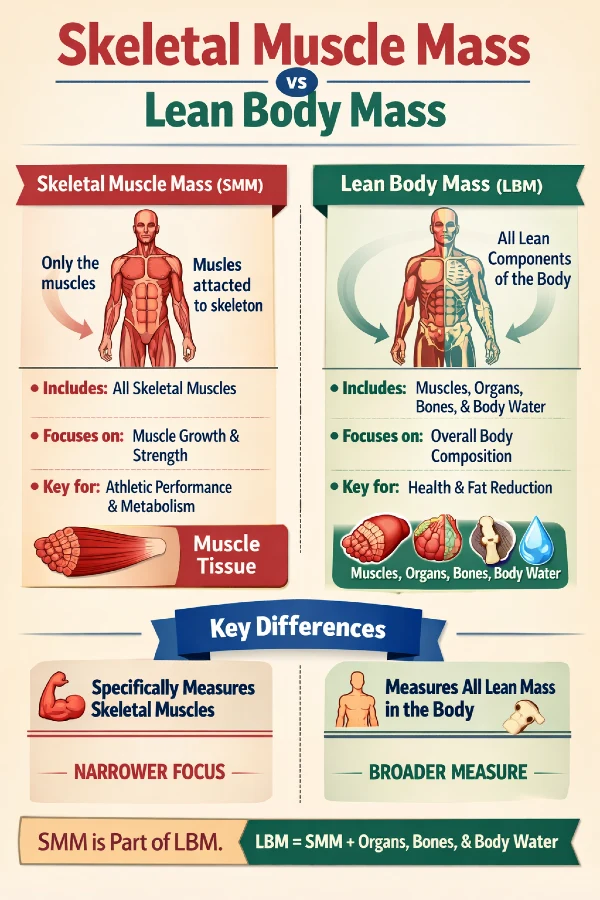
A common confusion in fitness is the difference between skeletal muscle mass and lean body mass.
Lean body mass includes everything in your body except fat. This means it includes muscles, bones, organs, and body water.
Skeletal muscle mass, on the other hand, refers only to the muscles attached to your bones.
This distinction is important when using calculators or tracking progress. Many people assume lean body mass equals muscle, but it actually represents a broader category.
How to Calculate Skeletal Muscle Mass
Direct measurement of skeletal muscle mass is not possible without advanced tools, but it can be estimated using several methods.
One common approach is using body composition analysis. Devices such as smart scales use bioelectrical impedance to estimate muscle mass based on resistance to electrical signals.
Another method involves calculating lean body mass first and then estimating the proportion of skeletal muscle.
A simplified formula approach:
Skeletal Muscle Mass ≈ Lean Body Mass × Muscle Percentage
Since lean body mass includes all non-fat components, a portion of it represents skeletal muscle.
Methods to Measure Skeletal Muscle Mass
There are several methods available, each with different levels of accuracy.
Bioelectrical impedance devices are the most accessible. These are commonly found in home body composition scales and provide quick estimates.
DEXA scans are more accurate and used in professional settings, but they are not practical for regular use.
Skinfold measurements and circumference-based methods can also give indirect insights when combined with formulas.
While no method is perfect, consistency is more important than precision. Using the same method over time allows you to track trends effectively.
Skeletal Muscle Mass Percentage
Instead of focusing only on total muscle weight, skeletal muscle mass is often expressed as a percentage of total body weight.
This makes it easier to compare across individuals and track changes over time.
For example, two people may have the same body weight, but one may have a higher muscle percentage and lower fat percentage, resulting in better body composition.
Ideal Skeletal Muscle Mass Range for Men & Women
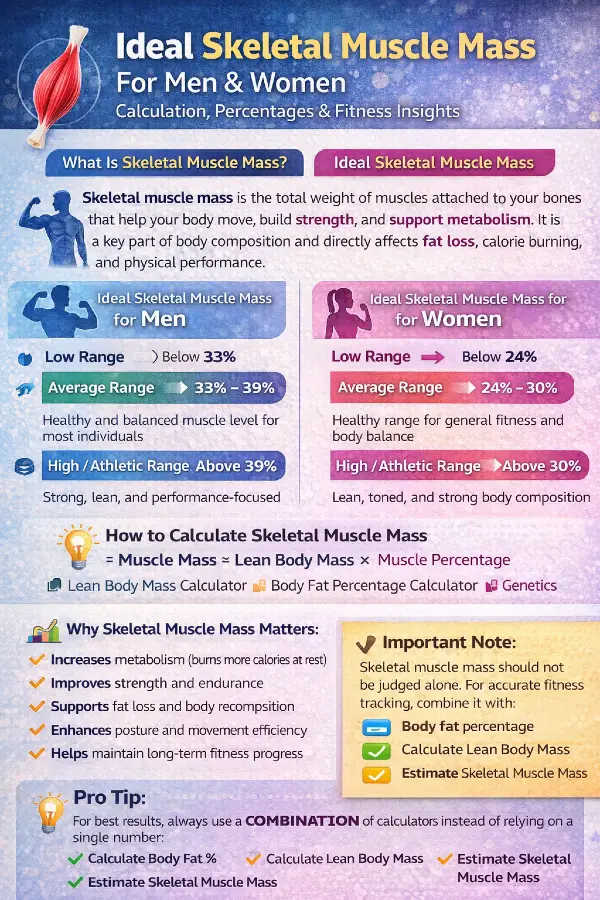
There is no single “perfect” number for skeletal muscle mass, but general ranges can help you understand where you stand.
For Men
Men naturally have higher muscle mass due to hormonal differences, especially testosterone levels.
Typical ranges:
- Low: Below 33%
- Average: 33% – 39%
- High: Above 39%
Athletes and highly trained individuals may exceed these ranges.
For Women
Women generally have lower skeletal muscle mass due to higher essential fat levels and different hormonal profiles.
Typical ranges:
- Low: Below 24%
- Average: 24% – 30%
- High: Above 30%
These ranges vary based on activity level, genetics, and fitness goals.
Factors That Affect Skeletal Muscle Mass
Several factors influence how much skeletal muscle a person has.
Age is a major factor. Muscle mass tends to decrease over time if not maintained. This process is gradual but noticeable without resistance training.
Gender also plays a role. Men typically have more muscle due to higher testosterone levels, while women have different body composition characteristics.
Physical activity is the most controllable factor. Strength training directly stimulates muscle growth, while inactivity leads to muscle loss.
Nutrition is equally important. Adequate protein intake supports muscle repair and growth, while insufficient nutrition can limit progress.
Genetics also influence muscle-building potential. Some individuals naturally build muscle more easily than others.
How to Increase Skeletal Muscle Mass
Increasing skeletal muscle mass requires a combination of training, nutrition, and recovery.
Resistance training is the primary driver of muscle growth. Exercises such as weightlifting, bodyweight training, and resistance band workouts stimulate muscle fibers.
Progressive overload is essential. This means gradually increasing the difficulty of your workouts over time to challenge your muscles.
Protein intake supports muscle repair. Consuming enough protein ensures your body has the building blocks needed for growth.
Recovery is often overlooked but critical. Muscles grow during rest, not during exercise. Proper sleep and recovery allow your body to adapt and improve.
Consistency is the most important factor. Muscle growth happens gradually over time, not instantly.
Can Skeletal Muscle Mass Decrease?
Yes, skeletal muscle mass can decrease if not maintained. This process is known as muscle loss.
Common causes include lack of physical activity, poor nutrition, and aging. When muscles are not used regularly, the body begins to break them down.
Muscle loss can reduce strength, slow metabolism, and affect overall body composition.
This is why maintaining muscle is just as important as building it.
Why Skeletal Muscle Mass Matters for Fat Loss
Skeletal muscle mass plays a significant role in fat loss.
Muscle tissue burns more calories than fat, even at rest. This means individuals with higher muscle mass have a higher resting metabolic rate.
This makes it easier to maintain a calorie deficit and lose fat over time.
Instead of focusing only on weight loss, improving muscle mass helps create better long-term results.
How to Track Skeletal Muscle Mass Progress
Tracking skeletal muscle mass helps you understand whether your fitness plan is effective.
Since direct measurement is difficult, tracking should focus on consistent methods.
Body composition scales provide estimates and can be used regularly.
Strength improvements are another strong indicator. If you are getting stronger, your muscle mass is likely improving.
Body measurements and progress photos also provide visual confirmation of changes.
Combining multiple tracking methods gives a more complete picture.
Common Misunderstandings About Skeletal Muscle Mass
Many people misunderstand how muscle mass works.
One common myth is that higher weight means more muscle. In reality, body weight includes fat, water, and other components.
Another misconception is that muscle can be built quickly. Muscle growth takes time and consistent effort.
Some believe cardio builds muscle, but while it supports health, resistance training is required for muscle growth.
Understanding these points helps set realistic expectations.
Final Thoughts
Skeletal muscle mass is a key factor in understanding body composition, fitness, and overall health. It represents the muscles responsible for movement and can be improved through proper training and nutrition.
Focusing on skeletal muscle mass rather than just body weight provides a more accurate picture of progress. It helps you build strength, improve metabolism, and achieve long-term fitness goals.
By combining consistent tracking, proper training, and balanced nutrition, you can effectively improve and maintain healthy skeletal muscle levels.
People Also Ask (PAA)
What is skeletal muscle mass?
Skeletal muscle mass is the total weight of muscles attached to bones that help your body move and perform physical activities.
How do you calculate skeletal muscle mass?
It can be estimated using body composition tools or by calculating lean body mass and determining the muscle portion within it.
What is a good skeletal muscle mass percentage?
For men, a good range is typically 33% to 39%, while for women it is around 24% to 30%.
Can skeletal muscle mass increase?
Yes, skeletal muscle mass can increase through resistance training, proper nutrition, and consistent exercise.
What Is Skeletal Muscle Mass – FAQs
What Is Skeletal Muscle Mass?
Skeletal muscle mass specifically refers to muscles attached to bones, while total muscle mass may include other muscle types.
Does skeletal muscle mass affect metabolism?
Yes, higher skeletal muscle mass increases calorie burning and improves metabolism.
How often should I track skeletal muscle mass?
Tracking every few weeks or monthly is enough to observe meaningful changes.
Can skeletal muscle mass decrease with age?
Yes, muscle mass naturally declines with age if not maintained through physical activity and proper nutrition.