
Adequate Intake (AI) is a recommended daily nutrient level established when there is not enough scientific evidence to determine an exact Recommended Dietary Allowance (RDA). It represents the amount of a nutrient that is assumed to be sufficient to maintain good health in most healthy individuals.
In simple terms, Adequate Intake is a safe and practical guideline used when researchers cannot calculate a precise daily requirement but still need to provide nutritional direction.
Understanding Adequate Intake is important for anyone focused on nutrition, fitness, hydration, and overall health.
What Is Adequate Intake? (Quick Definition)
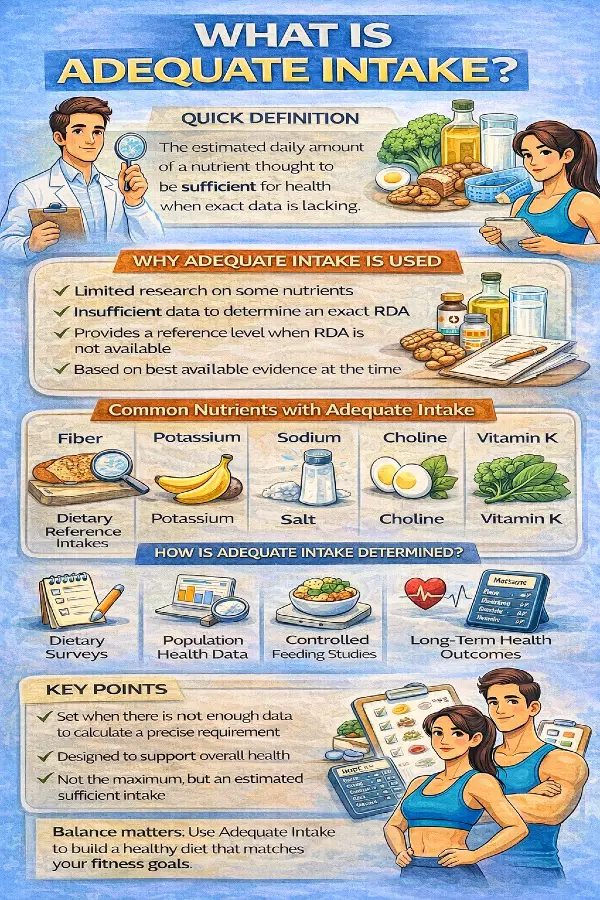
Adequate Intake (AI) is the daily amount of a nutrient estimated to be enough to support health when scientific data is insufficient to set an exact requirement.
Why Is Adequate Intake Used?
In nutrition science, some nutrients have strong research data that allows experts to determine a specific daily requirement. Others do not have enough evidence to calculate an exact number.
When there is limited data, health authorities establish an Adequate Intake instead of an RDA.
AI is based on:
- Observed nutrient intake in healthy populations
- Experimental research
- Clinical observations
- Nutritional patterns linked to good health
It is not random. It is built from the best available evidence at the time.
Who Sets Adequate Intake Levels?
Adequate Intake values are established by the National Academies of Sciences, Engineering, and Medicine through its Food and Nutrition Board. These recommendations are part of a larger system known as the Dietary Reference Intakes.
These intake levels vary depending on:
- Age
- Gender
- Life stage (pregnancy or breastfeeding)
- Health condition
AI values are updated when new research becomes available.
What Is the Difference Between AI and RDA?
Adequate Intake and Recommended Dietary Allowance both guide daily nutrient intake, but they are not the same.
The Recommended Dietary Allowance (RDA) is calculated using strong scientific evidence and meets the needs of nearly all healthy individuals.
Adequate Intake is used when evidence is insufficient to determine an RDA.
This means:
- RDA = scientifically calculated requirement
- AI = estimated sufficient intake
Both aim to support health, but RDA is more precise.
Which Nutrients Use Adequate Intake Instead of RDA?
Some nutrients do not have enough research data to establish an RDA. These nutrients rely on Adequate Intake values instead.
Common examples include:
- Fiber
- Potassium
- Sodium
- Vitamin K
- Choline
For example, fiber intake recommendations are often listed as Adequate Intake because exact minimum requirements are difficult to define.
How Is Adequate Intake Determined?
Adequate Intake is based on observed average intake levels of healthy people who show no signs of deficiency.
Researchers analyze:
- Dietary surveys
- Long-term health outcomes
- Controlled feeding studies
- Population health data
From this information, they estimate an intake level likely to meet nutritional needs.
It is a practical guideline rather than an exact requirement.
Is Adequate Intake Enough for Optimal Health?
Yes, Adequate Intake is designed to support good health for most individuals.
However, it does not represent a maximum limit or a personalized requirement. Individual needs may vary based on:
- Activity level
- Metabolism
- Body composition
- Medical conditions
- Fitness goals
For athletes or highly active individuals, nutrient needs may exceed standard Adequate Intake values.
Adequate Intake vs Tolerable Upper Intake Level
It is important to understand that Adequate Intake is not the maximum safe amount.
The maximum safe intake is known as the Tolerable Upper Intake Level (UL). Consuming nutrients above the UL may increase health risks.
AI focuses on minimum sufficiency, not upper safety limits.
Why Adequate Intake Matters for Fitness
For individuals focused on body composition, muscle growth, or fat loss, understanding Adequate Intake helps ensure nutritional balance.
Inadequate intake of key nutrients can affect:
- Energy levels
- Recovery
- Metabolism
- Hormone function
- Hydration balance
Meeting Adequate Intake supports:
- Stable energy production
- Proper muscle function
- Electrolyte balance
- Long-term metabolic health
It creates a strong nutritional foundation for fitness progress.
Can You Exceed Adequate Intake?
Yes, you can consume more than the Adequate Intake, especially through diet or supplementation. However, exceeding AI does not automatically improve health.
For some nutrients, excessive intake may cause imbalances or side effects.
Balance is more important than maximum intake.
How to Use Adequate Intake in Daily Nutrition
Adequate Intake should be used as a guideline, not a strict rule.
To apply AI effectively:
- Focus on whole foods
- Maintain dietary variety
- Avoid extreme restrictions
- Monitor overall calorie intake
- Adjust based on personal fitness goals
AI provides a baseline, but personalization improves results.
Final Thoughts
Adequate Intake is a scientifically informed estimate of daily nutrient needs when precise requirements cannot be determined. It provides a safe and practical foundation for maintaining health, supporting metabolism, and improving overall nutritional balance.
While it may not be as precise as an RDA, it remains an essential part of dietary guidance systems and plays an important role in fitness-focused nutrition planning.
Understanding Adequate Intake helps you build smarter eating habits and make informed decisions about nutrient intake.
People Also Ask (PAA)
What does adequate intake mean?
Adequate Intake means the estimated daily amount of a nutrient that is sufficient to support health when scientific evidence is not strong enough to establish an exact requirement.
Is adequate intake the same as recommended daily allowance?
No. Recommended Dietary Allowance is based on strong scientific data, while Adequate Intake is used when research is limited but still provides a safe estimate.
Is adequate intake enough for athletes?
Adequate Intake supports general health, but athletes may require higher amounts depending on training intensity, body composition, and energy expenditure.
Can you consume too much of a nutrient with an adequate intake value?
Yes. Adequate Intake does not represent the maximum safe level. Consuming excessive amounts beyond the Tolerable Upper Intake Level may cause health risks.
Frequently Asked Questions
-
Why is adequate intake important?
Adequate Intake ensures that individuals receive enough essential nutrients to prevent deficiency and support overall health, especially when precise requirements are unknown.
-
How is adequate intake calculated?
It is calculated based on observed intake levels of healthy populations and clinical evidence, rather than strict experimental minimum requirements.
-
Does adequate intake apply to everyone?
Adequate Intake values vary based on age, gender, and life stage. They are general guidelines for healthy individuals, not personalized prescriptions.
-
Should I aim for RDA or adequate intake?
If an RDA exists, that is the more precise target. If not, following Adequate Intake provides a reliable and safe guideline.