
No, body mass index is not the same as body fat percentage.
Many people confuse these two terms because both relate to weight and health. However, they measure completely different things. If you have ever checked your BMI and wondered why it does not match how your body looks, this guide will explain everything clearly.
By the end of this article, you will understand:
- What BMI actually measures
- What body fat percentage really shows
- Why they give different results
- Which one gives better health insight
- When to use each measurement
Let’s break it down in simple terms.
What Is Body Mass Index (BMI)?
Body Mass Index, or BMI, is a formula that compares your weight to your height.
It does not measure fat directly. It does not measure muscle. It simply uses math to estimate whether your body size falls within a general health range.
The formula looks like this:
BMI = weight (kg) ÷ height (m²)
If you do not want to calculate manually, you can use a BMI calculator to get your result instantly.
After calculation, BMI places you into categories:
- Underweight
- Normal weight
- Overweight
- Obese
These categories help doctors identify potential weight-related health risks. BMI works as a quick screening tool. It does not provide deep body analysis.
That is where many people misunderstand it.
What Does BMI Actually Measure?
BMI measures total body mass in relation to height.
It treats all weight the same. It does not know whether your weight comes from:
- Muscle
- Fat
- Bone
- Water
- Organs
If two people weigh the same and have the same height, they will have the same BMI. It does not matter if one has high muscle and the other has high body fat.
This limitation explains why BMI sometimes gives misleading impressions.
What Is Body Fat Percentage?
Body fat percentage tells you how much of your total body weight comes from fat.
For example, if you weigh 80 kg and 20 kg comes from fat, your body fat percentage is 25%.
Unlike BMI, this measurement separates fat from everything else in your body. It focuses only on stored fat tissue.
Your total body weight consists of:
- Fat mass
- Lean mass
Lean mass includes muscle, bones, water, and organs. If you want to understand this better, you can calculate your non-fat portion using a lean body mass calculator.
Body fat percentage gives a clearer picture of body composition.
BMI vs Body Fat Percentage: The Core Difference
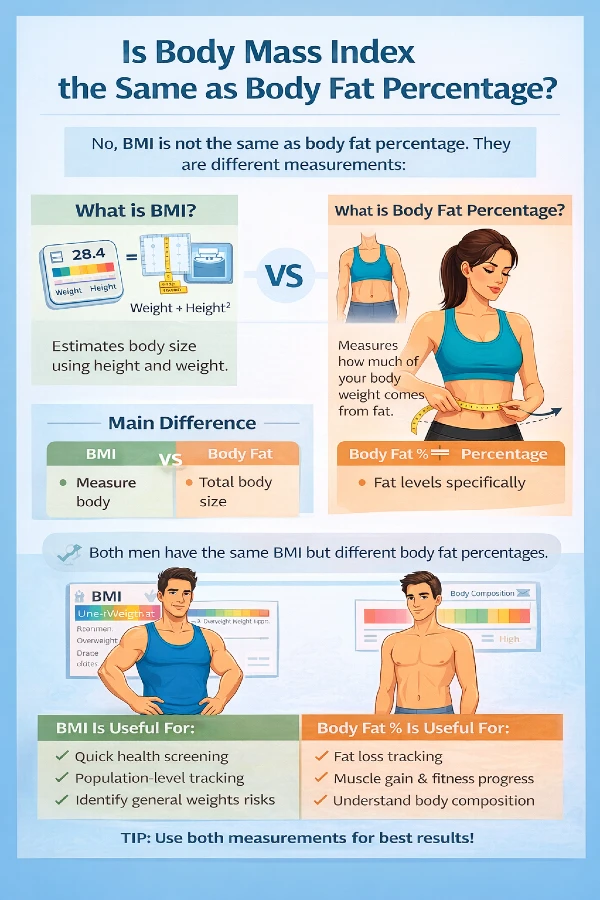
The difference is simple.
BMI measures body size.
Body fat percentage measures fat levels.
BMI uses height and weight.
Body fat percentage measures fat compared to total weight.
BMI gives you a category.
Body fat percentage tells you what your body consists of.
This difference matters because health risks relate more closely to fat levels than total body weight.
Why BMI and Body Fat Percentage Often Disagree
Many people notice that their BMI result does not match how they look.
Here is why.
1. Muscle Increases Weight
Muscle weighs more than fat. If you build muscle, your weight increases. BMI increases too.
However, your body fat may stay the same or even decrease.
Athletes often fall into the “overweight” BMI category even though they have low body fat.
2. Low Muscle Can Hide High Fat
Some people have low muscle mass and higher fat levels. Their total weight may look normal, so their BMI stays in the normal range.
However, their body fat percentage may be higher than healthy levels.
BMI cannot detect this situation.
3. Body Shape Differences
BMI does not consider where fat is stored. Fat stored around the abdomen carries higher health risk than fat stored elsewhere.
For better risk assessment, you can combine BMI with waist measurement or a waist-to-hip ratio calculator.
Which One Is More Accurate?
If your goal is to understand fat levels, body fat percentage gives more accurate information.
If your goal is quick health screening, BMI works well.
BMI helps identify population-level risk trends. It provides a simple way to classify millions of people quickly.
Body fat percentage helps individuals track real body changes.
For example:
If your BMI stays the same but your body fat percentage drops, you likely gained muscle and lost fat. That is positive progress.
BMI alone cannot show that.
When Should You Use BMI?
Use BMI when you want:
- A quick health screening
- A general weight classification
- A starting point for health assessment
Many health systems use BMI because it is simple and fast.
However, do not rely on BMI alone if you:
- Strength train regularly
- Have high muscle mass
- Want to track fat loss
- Want detailed body composition insight
When Should You Use Body Fat Percentage?
Use body fat percentage when you want:
- Fat loss tracking
- Muscle-building progress monitoring
- Better body composition insight
- More personalized health tracking
If you combine body fat percentage with lean mass calculation, you get a full picture of your body structure.
Can You Have a Healthy BMI but Unhealthy Fat?
Yes, this happens often.
Someone may have a BMI within the normal range but still carry excess fat. This condition is sometimes called “normal weight obesity.”
BMI cannot detect hidden fat distribution.
That is why experts recommend combining:
- BMI
- Body fat percentage
- Waist measurement
Using multiple tools gives clearer insight.
Can You Have High BMI but Low Body Fat?
Yes.
Bodybuilders and athletes often have high BMI due to muscle mass. Muscle increases weight, but it does not increase fat percentage.
In such cases, BMI may classify someone as overweight, even though their fat levels remain low.
This example clearly shows that BMI does not measure fat directly.
How to Calculate BMI and Body Fat Percentage
You can calculate BMI easily using height and weight. A BMI calculator simplifies the process.
To estimate body fat percentage, you can use:
- Body fat calculators
- Smart body composition scales
- Skinfold calipers
- Bioelectrical impedance tools
Online tools provide quick estimates using measurements such as waist, neck, height, and weight.
If you want deeper understanding, calculate your lean body mass alongside body fat percentage.
Why Many People Misunderstand These Terms
People often assume BMI equals fat because higher BMI categories associate with higher health risks.
However, BMI measures size, not fat tissue.
Media headlines and fitness advice sometimes oversimplify this difference. That creates confusion.
Understanding the distinction helps you avoid unnecessary stress about numbers.
Which Measurement Predicts Health Risk Better?
Body fat distribution plays a stronger role in health risk than BMI alone.
Excess abdominal fat increases risk for:
- Heart disease
- Type 2 diabetes
- High blood pressure
BMI can indicate risk at a broad level, but body fat percentage and waist measurement provide better individual insight.
For best results, use both instead of choosing only one.
The Best Approach: Use Both Together
Instead of asking which one is better, ask how they work together.
Here is a smart approach:
- Check your BMI for general classification.
- Measure your body fat percentage for composition insight.
- Track your lean mass to monitor muscle.
- Measure your waist for fat distribution.
This combined strategy gives a complete picture.
Relying on one number limits understanding.
Final Answer
Body mass index is not the same as body fat percentage.
BMI measures total body weight relative to height.
Body fat percentage measures how much of your body weight comes from fat.
BMI gives a category.
Body fat percentage gives detailed composition insight.
If you want accurate body tracking, combine both measurements instead of relying on one alone.
Understanding this difference helps you make smarter health decisions.
People Also Ask
Is BMI the same as body fat percentage?
No. BMI estimates body size using height and weight. Body fat percentage measures the amount of fat in your body.
Why is BMI not accurate for athletes?
Athletes often have higher muscle mass. Muscle increases weight, which raises BMI even if fat levels stay low.
Which is better for tracking fat loss?
Body fat percentage works better for tracking fat loss because it focuses only on fat tissue.
Can BMI misclassify healthy people?
Yes. BMI may classify muscular individuals as overweight and may not detect high fat levels in people with low muscle mass.
Should I rely on BMI alone?
No. Combine BMI with body fat percentage and waist measurements for better health insight.
Is BMI Same as Body Fat Percentage – FAQs
-
Is Body Mass Index the Same as Body Fat Percentage?
No. Body mass index (BMI) and body fat percentage measure different things. BMI compares your weight to your height to estimate body size. Body fat percentage shows how much of your total body weight comes from fat.
-
Which is more accurate: BMI or body fat percentage?
Body fat percentage is more accurate for measuring fat levels. BMI only estimates weight relative to height and cannot tell how much of that weight comes from fat or muscle.
-
Can you have a normal BMI but high body fat?
Yes. A person can have a normal BMI but still carry excess body fat. This often happens when muscle mass is low and fat levels are higher than healthy ranges. BMI does not detect body composition differences.
-
Can you have a high BMI but low body fat?
Yes. Athletes and people with high muscle mass often have a higher BMI because muscle adds weight. However, their body fat percentage may remain low.
-
Why does BMI not measure body fat directly?
BMI uses only height and total body weight in its calculation. It does not separate fat from muscle, bone, or water. That is why it cannot measure fat directly.
-
Should I track BMI or body fat percentage?
You should track both. BMI gives a quick general health classification. Body fat percentage provides deeper insight into fat levels and body composition.
-
What is a healthy body fat percentage?
Healthy body fat ranges vary by age and gender. In general, lower fat levels within a healthy range support better metabolic health. For accurate guidance, compare your result with standard health charts.
-
How can I calculate my BMI?
You can calculate BMI using your height and weight. The formula divides weight in kilograms by height in meters squared. You can also use a BMI calculator for faster results.
-
How can I measure my body fat percentage?
You can measure body fat percentage using body composition scales, skinfold tools, or online calculators that use body measurements such as waist, neck, height, and weight.
-
Why do doctors still use BMI?
Doctors use BMI because it provides a simple and fast screening tool. It helps identify potential weight-related risks at a population level, even though it does not measure body fat directly.