
If you want to lose fat, build muscle, or maintain your weight, you must understand how to calculate total energy correctly. In fitness, total energy refers to the total number of calories your body uses in a full day. This is commonly known as Total Daily Energy Expenditure (TDEE).
Many people follow diet plans without knowing how many calories their body actually needs. That leads to slow results or no results at all. When you understand your total energy requirement, you stop guessing and start making precise decisions.
This article explains clearly what total energy means, how to calculate it, and how to use it properly for your fitness goals.
What Is Total Energy in Fitness?
In a fitness context, total energy means the total amount of calories your body burns in 24 hours. Your body is constantly using energy, even when you are not exercising. Energy is required to keep your heart beating, lungs working, brain functioning, and cells repairing themselves.
On top of that, you burn additional calories when you walk, work, exercise, digest food, and perform daily tasks. When you combine all of these energy uses together, you get your total daily energy expenditure.
This number determines whether you gain weight, lose weight, or maintain your current body composition. If you eat more calories than your total energy, your body stores the excess as fat. If you eat fewer calories than your total energy, your body uses stored energy, leading to fat loss. If your calorie intake matches your total energy output, your weight stays stable.
The Formula to Calculate Total Energy
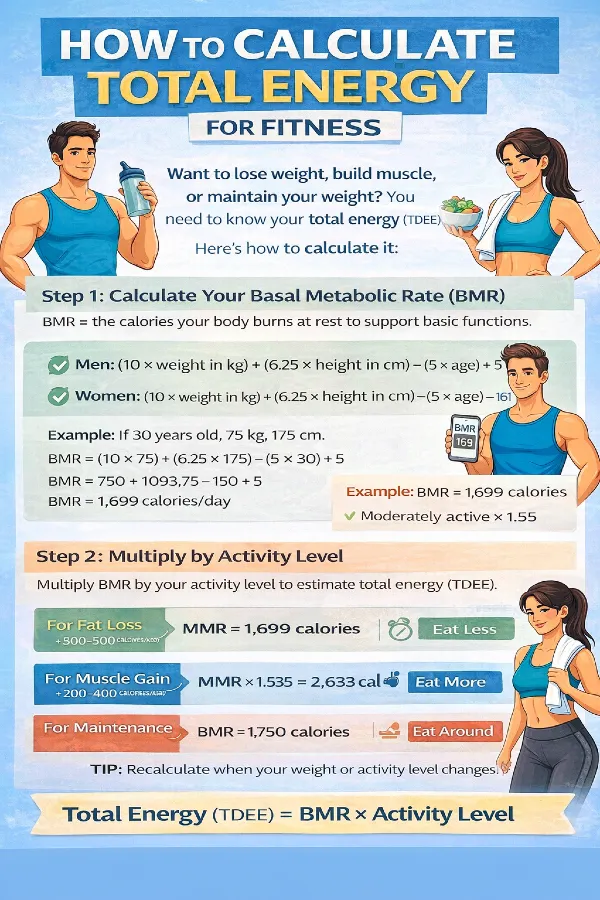
Calculating total energy involves two main steps. First, you calculate your Basal Metabolic Rate (BMR). Then, you multiply that number by your activity level.
The formula is simple:
Total Energy (TDEE) = BMR × Activity Level
This formula works because BMR represents your base calorie burn at rest, and the activity multiplier adjusts it according to how active you are.
Step 1: Calculate Your Basal Metabolic Rate (BMR)
Your Basal Metabolic Rate is the number of calories your body burns at complete rest. Even if you were lying down all day without moving, your body would still require energy to survive. BMR covers essential processes such as breathing, blood circulation, hormone regulation, and organ function.
The most commonly used formula to estimate BMR is the Mifflin-St Jeor equation.
For men:
BMR = (10 × weight in kg) + (6.25 × height in cm) − (5 × age) + 5
For women:
BMR = (10 × weight in kg) + (6.25 × height in cm) − (5 × age) − 161
This equation gives a reliable estimate for most healthy adults.
For example, if a 30-year-old male weighs 75 kg and is 175 cm tall, his BMR would be calculated as follows:
(10 × 75) + (6.25 × 175) − (5 × 30) + 5
750 + 1093.75 − 150 + 5 = 1698.75
His estimated BMR would be approximately 1,699 calories per day. That means his body burns around 1,699 calories daily even without exercise.
You can calculate this manually or use a BMR calculator for faster results.
Step 2: Adjust for Activity Level
Once you know your BMR, the next step is to account for your physical activity. No one stays completely at rest throughout the day. Your movement, workouts, and daily habits increase your energy expenditure.
Activity multipliers are used to estimate this increase:
- Sedentary (little or no exercise): 1.2
- Lightly active (1–3 workouts per week): 1.375
- Moderately active (3–5 workouts per week): 1.55
- Very active (6–7 workouts per week): 1.725
- Extremely active (intense training and physical job): 1.9
If the example person above is moderately active, his total energy would be:
1,699 × 1.55 = 2,633 calories per day
This means he needs about 2,633 calories daily to maintain his weight.
This number represents his Total Daily Energy Expenditure.
What Contributes to Total Energy?
Total energy expenditure is not just exercise calories. It is made up of several components that work together throughout the day.
The largest part is Basal Metabolic Rate, which usually accounts for about 60 to 70 percent of daily calories burned. Physical activity comes next and varies depending on how active you are. Non-exercise activity, such as walking around the house or standing at work, also contributes significantly. Finally, your body burns calories while digesting food, which is known as the thermic effect of food.
When all of these components are combined, they create your total daily energy requirement.
How to Use Total Energy for Fat Loss
If your goal is fat loss, you must create a calorie deficit. This means eating fewer calories than your total energy expenditure. A moderate deficit of 300 to 500 calories per day is generally considered sustainable and safer for long-term progress.
For example, if your total energy is 2,600 calories, reducing your intake to around 2,100 to 2,300 calories can promote steady fat loss.
Tracking body fat percentage alongside total energy gives a clearer picture of progress. Weight alone does not always reflect fat loss accurately.
How to Use Total Energy for Muscle Gain
If your goal is muscle gain, you need a calorie surplus. This means consuming slightly more calories than your total energy expenditure. A small surplus of 200 to 400 calories per day is usually enough to support muscle growth without excessive fat gain.
For example, if your total energy is 2,600 calories, increasing intake to around 2,800 to 3,000 calories can support muscle building when combined with proper strength training.
Muscle gain also gradually increases your metabolic rate because muscle tissue burns more calories than fat tissue.
Why Total Energy Changes Over Time
Your total energy needs are not fixed. They change as your body changes. If you lose weight, your BMR decreases slightly because your body mass becomes lower. If you gain muscle, your BMR may increase. Changes in activity level also affect total energy.
Age can influence metabolism as well. As you grow older, metabolic rate may gradually decline.
Because of these changes, it is recommended to recalculate your total energy every four to six weeks or after significant weight changes.
Common Mistakes When Calculating Total Energy
Many people overestimate their activity level, which leads to consuming too many calories. Others forget to adjust their calorie intake after losing weight. Some people rely only on scale weight instead of monitoring body composition.
Being honest about your lifestyle and tracking your intake consistently improves accuracy.
Total Energy and Other Fitness Metrics
Total energy works best when combined with other measurements. For example, Body Mass Index (BMI) helps estimate body size relative to height. Body fat percentage gives insight into how much of your body mass comes from fat tissue. Lean body mass reflects muscle and other non-fat components.
Using total energy alongside these metrics gives a more complete understanding of your progress.
Final Summary
Total energy in fitness refers to the total number of calories your body burns in one day. It is calculated by multiplying your Basal Metabolic Rate by your activity level.
The formula is simple:
Total Energy = BMR × Activity Level
Once you know this number, you can adjust your calorie intake according to your goal. Eating below this number leads to fat loss. Eating above it supports muscle gain. Eating at this level maintains your current weight.
Understanding how to calculate total energy allows you to stop guessing and start managing your fitness results with precision.
People Also Ask
What is total energy in fitness?
Total energy in fitness refers to the total number of calories your body burns in one day. This includes calories burned at rest (Basal Metabolic Rate), during physical activity, through daily movement, and while digesting food. It is also known as Total Daily Energy Expenditure (TDEE).
How do you calculate total energy expenditure?
To calculate total energy expenditure, first calculate your Basal Metabolic Rate (BMR) using a standard formula. Then multiply your BMR by your activity level.
Total Energy (TDEE) = BMR × Activity Level
This gives you the number of calories your body needs per day to maintain your current weight.
Is total energy the same as calories?
Yes. In nutrition and fitness, total energy is measured in calories. When someone says they need 2,500 calories per day, they are referring to their total daily energy requirement.
How many calories should I eat per day?
The number of calories you should eat depends on your total energy expenditure. If your goal is weight maintenance, eat close to your TDEE. For fat loss, eat 300–500 calories below it. For muscle gain, eat 200–400 calories above it.
Does total energy include exercise?
Yes. Total energy includes all calories burned during exercise, daily activities, and resting metabolism. Exercise is just one part of total daily energy expenditure.
Why is my total energy different from someone else’s?
Total energy varies based on weight, height, age, gender, muscle mass, and activity level. Even two people with the same weight can have different energy needs due to differences in body composition and lifestyle.
PAA Summary
Total energy in fitness is the total number of calories your body burns in one day. It is calculated by multiplying your Basal Metabolic Rate (BMR) by your activity level. This number determines how many calories you should eat to lose fat, gain muscle, or maintain your weight.
How to Calculate Total Energy – FAQs
How to Calculate Total Energy
The formula used in fitness is:
Total Energy (TDEE) = Basal Metabolic Rate (BMR) × Activity Level
BMR is calculated using your weight, height, age, and gender. The activity level multiplier adjusts the number based on how active you are.
How accurate is the total energy calculation?
Total energy calculations provide an estimate, not an exact number. They are generally accurate enough to guide fat loss, muscle gain, or weight maintenance when monitored and adjusted over time. Tracking progress and recalculating every few weeks improves accuracy.
How often should I recalculate my total energy?
You should recalculate your total energy if you:
Lose or gain significant weight
Change your activity level
Notice progress slowing down
Increase muscle mass
Recalculating every 4–6 weeks is a good practice.
Can total energy increase over time?
Yes. Total energy can increase if you build muscle, become more active, or improve metabolic health. Muscle tissue burns more calories than fat tissue, which slightly raises your daily energy needs.
What happens if I eat below my total energy?
Eating below your total energy creates a calorie deficit. Over time, this leads to fat loss because your body uses stored energy to make up the difference. However, an extreme deficit can slow metabolism and reduce muscle mass.
What happens if I eat above my total energy?
Eating above your total energy creates a calorie surplus. This can lead to weight gain. If combined with strength training, some of that gain may be muscle mass. Without training, most surplus calories are stored as fat.
Is BMR the same as total energy?
No. BMR is only the calories your body burns at rest. Total energy includes BMR plus physical activity, daily movement, and digestion. Total energy is always higher than BMR.
Do I need to count calories to manage total energy?
While not mandatory, tracking calories makes it easier to manage total energy accurately. Even rough tracking can help you stay aligned with your goals and adjust intake when needed.