
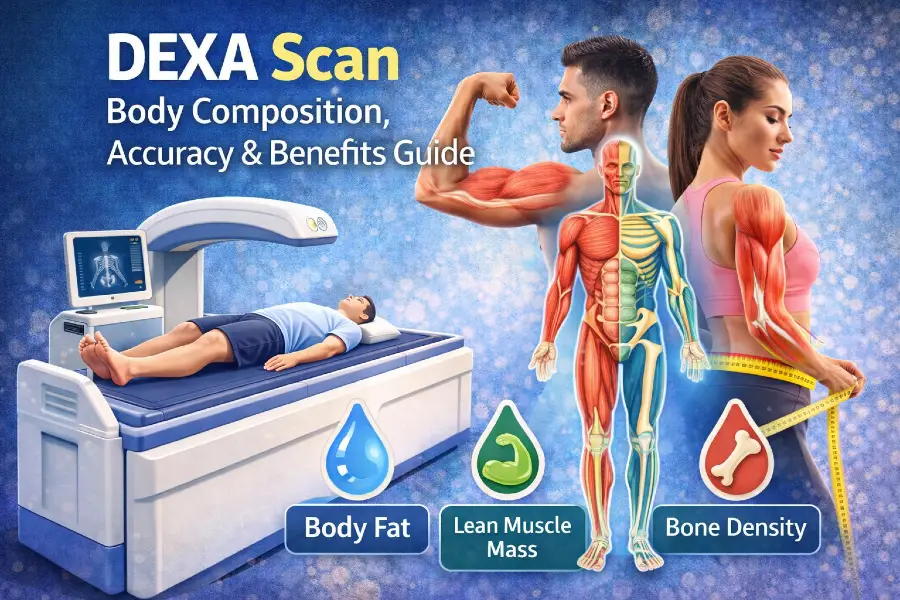
DEXA scans are one of the most accurate methods for measuring body composition, including body fat percentage, lean mass, and bone density. In fitness and health tracking, they are widely considered the gold standard because they provide detailed insights that cannot be obtained from regular weighing scales or basic calculators.
Unlike simple measurements such as body weight or BMI, a DEXA scan shows how your body is actually composed. It separates fat, muscle, and bone into distinct categories, allowing you to understand exactly what is changing in your body.
For anyone serious about tracking fat loss, muscle gain, or overall body composition, DEXA scans provide a level of precision that most other methods cannot match.
What Is a DEXA Scan? (Quick Answer)
A DEXA scan is a body composition test that uses low-dose X-rays to measure body fat, lean muscle mass, and bone density with high accuracy.
How DEXA Scans Work
DEXA stands for Dual-Energy X-ray Absorptiometry. The scan uses two different X-ray beams that pass through the body at different energy levels.
These beams measure how much energy is absorbed by different tissues. Since fat, muscle, and bone absorb energy differently, the scan can distinguish between them and calculate their exact proportions.
The result is a detailed report that shows:
- Total body fat percentage
- Lean body mass
- Skeletal muscle distribution
- Bone density
- Regional fat distribution (arms, legs, trunk)
This makes DEXA scans far more detailed than traditional methods.
What Does a DEXA Scan Measure?
A DEXA scan provides a complete breakdown of your body composition. Instead of giving just one number, it shows how your weight is distributed across different components.
The scan measures total body fat and shows where fat is stored. This is important because fat distribution affects health and fitness outcomes.
It also measures lean mass, which includes skeletal muscle. This helps you understand how much muscle you have and whether you are gaining or losing it over time.
Bone density is another key measurement. While this is more relevant for health screening, it also provides additional insight into overall body structure.
Why DEXA Scans Are Considered the Gold Standard
DEXA scans are widely regarded as one of the most accurate body composition methods available.
Unlike BMI, which only uses height and weight, DEXA provides real data about fat and muscle distribution.
Compared to bioelectrical impedance scales, DEXA is less affected by hydration levels, food intake, or daily fluctuations.
This accuracy makes it especially useful for:
- Tracking fat loss progress
- Monitoring muscle gain
- Evaluating body recomposition
- Assessing long-term fitness changes
Because of this, many athletes and fitness professionals rely on DEXA scans for precise tracking.
DEXA Scan vs Other Body Composition Methods
There are several ways to measure body composition, but they vary in accuracy.
Basic weighing scales only measure total body weight and do not distinguish between fat and muscle.
BMI provides a general estimate but does not reflect body composition at all.
Bioelectrical impedance devices estimate body fat using electrical signals, but results can vary based on hydration and other factors.
Skinfold measurements can be useful but depend heavily on technique and experience.
DEXA scans stand out because they directly measure body composition using imaging technology rather than estimation.
Benefits of DEXA Scans for Fitness
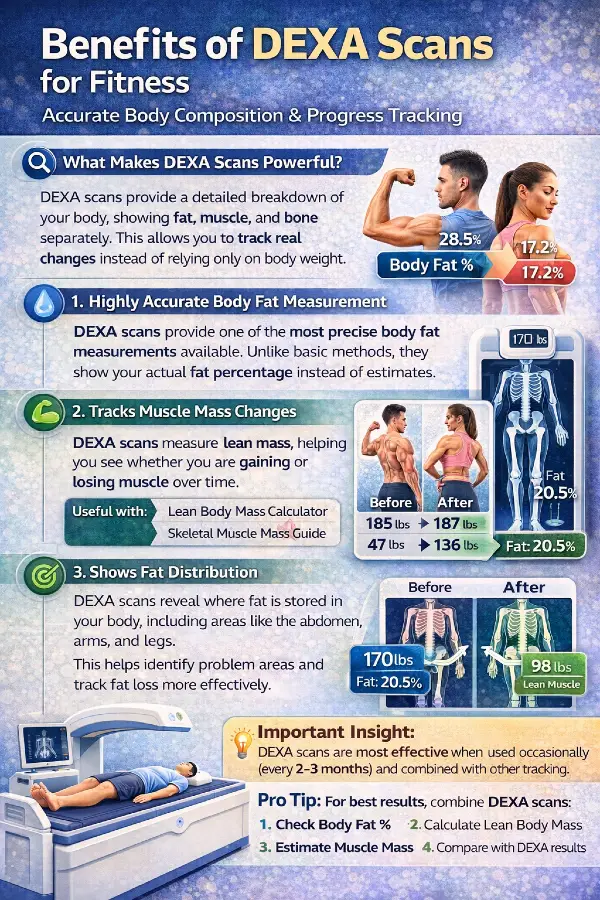
DEXA scans provide several advantages for people focused on fitness and body transformation.
One of the biggest benefits is accuracy. Knowing your exact body fat percentage allows you to set realistic goals and track progress effectively.
Another advantage is regional analysis. You can see where fat is stored and how it changes over time.
DEXA scans also help identify muscle imbalances. This can be useful for improving training programs and preventing injury.
For people working on body recomposition, DEXA scans show whether you are gaining muscle while losing fat, even if your weight stays the same.
Are DEXA Scans Safe?
DEXA scans use very low levels of radiation, much lower than standard medical X-rays.
For most people, the exposure is minimal and considered safe when used occasionally.
The scan is non-invasive and painless. You simply lie on a table while the machine scans your body.
There is no recovery time, and the entire process usually takes around 10 to 20 minutes.
How to Prepare for a DEXA Scan
Preparation can affect the accuracy of your results. To ensure consistency, it is important to follow the same routine each time.
Avoid heavy meals before the scan, as food in your system can slightly affect readings.
Hydration levels should be consistent. Drinking too much or too little water can influence body composition results.
Wear light clothing without metal objects, as metal can interfere with the scan.
Try to schedule scans at the same time of day for better comparison.
How Often Should You Get a DEXA Scan?
DEXA scans are not needed frequently because body composition changes gradually.
Most people benefit from scanning every 2 to 3 months. This allows enough time for noticeable changes in fat and muscle.
Frequent scanning is unnecessary and does not provide additional useful insight.
Limitations of DEXA Scans
While DEXA scans are highly accurate, they are not perfect.
Results can still vary slightly based on hydration, food intake, and machine calibration.
DEXA scans are also less accessible than other methods, as they require specialized equipment and are usually done in clinics or fitness centers.
Cost can also be a factor, making it less practical for frequent use.
Despite these limitations, DEXA remains one of the most reliable methods available.
DEXA Scans and Skeletal Muscle Mass
DEXA scans provide a detailed estimate of lean mass, which includes skeletal muscle.
While they do not directly isolate skeletal muscle alone, they offer one of the best available estimates.
Are DEXA Scans Necessary?
DEXA scans are not required for everyone. Many people can track progress effectively using simpler methods.
However, they are valuable for those who want precise data or are working toward specific fitness goals.
If you are serious about body recomposition or want detailed insights, DEXA scans can provide useful information.
Final Thoughts
DEXA scans are one of the most accurate tools for measuring body composition. They provide detailed insights into fat, muscle, and bone, helping you understand how your body is changing over time.
While they are not necessary for everyone, they offer valuable data for those focused on fitness, fat loss, or muscle gain.
When used alongside calculators and consistent tracking methods, DEXA scans can significantly improve your understanding of body composition and progress.
People Also Ask (PAA)
What is a DEXA scan used for?
A DEXA scan is used to measure body fat, lean muscle mass, and bone density with high accuracy.
How accurate are DEXA scans?
DEXA scans are highly accurate and are considered one of the best methods for measuring body composition.
Are DEXA scans safe?
Yes, DEXA scans use very low radiation and are considered safe for occasional use.
Can a DEXA scan measure muscle mass?
DEXA scans estimate lean body mass, which includes skeletal muscle, providing a reliable indication of muscle levels.
DEXA Scans – FAQs
How long does a DEXA scan take?
A DEXA scan typically takes 10 to 20 minutes to complete.
Do I need to prepare for a DEXA scan?
Yes, maintaining consistent hydration and avoiding heavy meals before the scan can improve accuracy.
How often should I do a DEXA scan?
Every 2 to 3 months is sufficient to track meaningful changes.
Is DEXA better than BMI?
Yes, DEXA is far more accurate because it measures actual body composition instead of just height and weight.