
Measuring your hips with a measuring tape is one of the most reliable ways to track changes in body size. Whether you are monitoring fitness progress, checking body proportions, or simply recording your measurements, accuracy is essential.
Although the process appears simple, many people unknowingly make small mistakes that lead to inconsistent or incorrect results. These mistakes often come from incorrect tape placement, uneven alignment, or inconsistent measuring habits. Over time, these small errors can make it difficult to track real progress.
This guide explains in detail how to measure your hips with a measuring tape correctly, how to maintain consistency, and how to avoid common errors so your measurements reflect actual body changes.
How to Measure Hips with Measuring Tape (Quick Answer)
To measure your hips with a measuring tape, stand upright with your feet together and wrap a flexible tape around the widest part of your hips and buttocks. Keep the tape level and parallel to the ground, ensure it is snug but not tight, and record the measurement accurately.
Understanding What Hip Measurement Represents
Hip measurement refers to the circumference of the widest part of your lower body, typically around the buttocks. It is not the same as waist measurement, and it should not be taken near the stomach or thighs.
This measurement reflects the overall size of the hip area, including muscle, fat, and bone structure. Because of this, it is commonly used to track physical changes over time.
When measured consistently, hip circumference provides a clear picture of whether your body size is increasing, decreasing, or staying stable. However, its usefulness depends entirely on how accurately it is measured.
Preparing to Measure Your Hips
Before taking a measurement, it is important to prepare properly. This helps reduce small variations that can affect accuracy.
Use a soft, flexible measuring tape that can easily wrap around your body. Avoid rigid or metal tapes, as they do not conform to body shape.
Stand in a relaxed position with your body upright. Your posture should be natural, not forced. If possible, stand in front of a mirror so you can check the tape alignment.
Try to measure under similar conditions each time. Consistency in timing, posture, and environment ensures that your measurements are comparable.
Step-by-Step: How to Measure Hips with a Measuring Tape
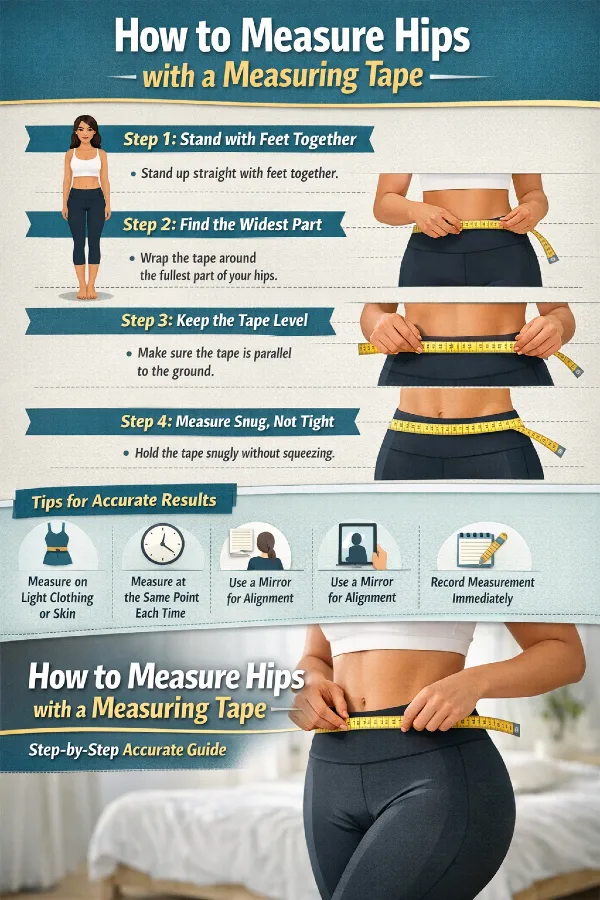
Start by standing straight with your feet together. Keeping your feet together helps maintain a consistent body position and prevents slight widening of the hips.
Wrap the measuring tape around your hips at the widest point. This is usually the fullest part of your buttocks. The tape should pass evenly around your body without twisting.
Check the position of the tape carefully. It must remain level all the way around. If the tape slopes upward or downward, the measurement will not be accurate.
Hold the tape so that it rests against your body. It should be snug enough to stay in place but not tight enough to compress the skin.
Keep your body relaxed and avoid tightening your muscles. Breathing normally also helps maintain a natural body position.
Once everything is properly aligned, read the measurement and record it immediately. Taking a second measurement can help confirm accuracy.
Finding the Widest Point of Your Hips
The most important part of measuring hips is identifying the correct measuring point. The tape should be placed at the widest part of your hips and buttocks.
This point may vary slightly from person to person. For some, it is directly across the center of the buttocks. For others, it may be slightly higher or lower.
The key is to find the point where your body naturally extends the most. Once identified, always measure at this same location to maintain consistency.
Measuring too high near the waist or too low near the thighs will not reflect true hip circumference and will lead to incorrect results.
Importance of Keeping the Tape Level
A level measuring tape is essential for accuracy. If the tape is not parallel to the ground, the measurement will be distorted.
One common issue is the tape rising at the back or dipping at the front. This often happens when measuring alone without checking alignment.
Using a mirror helps you ensure the tape stays horizontal. You can also lightly adjust the tape before recording the measurement to correct any uneven positioning.
Even a small tilt can change the final number, so taking a moment to check alignment is important.
How Tight Should the Tape Be?
The tension of the measuring tape has a direct impact on the result. The tape should be snug but not tight.
If the tape is pulled tightly, it presses into the skin and reduces the measurement. This creates a smaller number than your actual hip size.
If the tape is too loose, it hangs away from the body and increases the measurement.
The correct tension is when the tape rests evenly against your body without leaving marks or gaps. Maintaining the same tension each time ensures reliable tracking.
Avoiding Common Measurement Errors
Many inconsistencies in hip measurements come from small but repeated mistakes.
Measuring at slightly different positions each time is one of the most common issues. Even a small shift in placement can change the result.
Another frequent mistake is measuring over thick clothing. This adds extra volume and does not reflect your actual body size.
Posture also affects measurement. Standing unevenly or shifting weight to one side can slightly change hip circumference.
Breathing and muscle tension can also influence results. Holding your breath or tightening your body may alter the measurement slightly.
Avoiding these mistakes helps ensure that your measurements are accurate and consistent.
Measuring Alone vs With Assistance
You can measure your hips on your own, but accuracy improves when someone assists you.
When measuring alone, it can be difficult to check whether the tape is level at the back. A mirror can help, but it may not always show the full alignment.
If possible, having someone else hold the tape and check alignment ensures a more precise measurement. However, with careful attention, self-measurement can still be reliable.
How to Ensure Consistency Over Time
Consistency is the most important factor in tracking hip measurements. Even if your measurement is slightly off, using the same method each time allows you to track changes accurately.
Measure at the same point, use the same tape, and maintain the same posture. Try to measure at the same time of day to reduce small fluctuations.
Repeating the measurement and comparing results can help confirm accuracy. If both readings are similar, you can be confident in the result.
When to Measure Your Hips
Timing can influence consistency. Your body may experience small fluctuations throughout the day due to food intake, hydration, and activity levels.
For best results, measure under similar conditions each time. Avoid measuring immediately after exercise, as temporary changes may affect the reading.
Choosing a consistent routine for measuring helps reduce variation and improves reliability.
Tracking Changes Using Hip Measurements
Hip measurements are most useful when tracked over time. A single measurement provides limited information, but repeated measurements show trends.
Changes in hip size may occur gradually. Measuring regularly allows you to see whether your body size is increasing, decreasing, or remaining stable.
It is important to focus on long-term patterns rather than small day-to-day differences.
Why Accurate Hip Measurement Matters
Accurate hip measurement ensures that your data reflects real changes in your body. Inaccurate measurements can create confusion and make it difficult to assess progress.
When measured correctly, hip circumference becomes a dependable reference point for tracking body size.
Maintaining proper technique allows you to rely on your measurements and make informed decisions based on them.
Final Thoughts
Measuring your hips with a measuring tape is simple, but accuracy depends on correct technique. The most important factors are placing the tape at the widest point, keeping it level, and maintaining consistent tension.
By following the same method each time and avoiding common mistakes, you can ensure that your measurements are reliable and useful.
Consistency, not perfection, is what makes hip measurement an effective tool for tracking changes over time.
People Also Ask (PAA)
How do you measure hips with a measuring tape?
Wrap a flexible measuring tape around the widest part of your hips and buttocks. Keep the tape level and snug without pulling it tight, then record the measurement.
Where should the tape be placed when measuring hips?
The tape should be placed around the widest part of your hips, usually the fullest area of the buttocks.
Should the tape be tight when measuring hips?
No, the tape should be snug but not tight. It should touch the body without compressing the skin.
Can I measure my hips alone?
Yes, you can measure your hips alone. Using a mirror helps ensure the tape is level and correctly positioned
How to Measure Hips with Measuring Tape – FAQs
What is the correct hip measurement technique?
The correct technique is to measure at the widest part of your hips with a level tape that is snug but not tight.
How often should I measure my hips?
Measuring once every two to four weeks is enough to track changes accurately.
Is it better to measure hips over clothes?
Measuring directly on the body or over light clothing gives more accurate results.
Why are my hip measurements inconsistent?
Inconsistencies usually occur due to changes in tape placement, tightness, posture, or measuring conditions.