
To properly measure your waist, place a flexible measuring tape around your natural waistline, keep it level with the floor, and take the measurement while standing relaxed after a normal exhale. This method provides the most accurate waist measurement for health tracking, fitness goals, and body-related calculations.
Waist measurement plays a key role in many health tools and calculators, including those used to estimate body fat distribution, metabolic risk, and overall body proportions. That is why measuring it correctly matters more than most people think.
What Does Waist Measurement Mean?
Waist measurement refers to the circumference of your natural waistline. It reflects how body mass and fat are distributed around your midsection.
Unlike body weight alone, waist size focuses on central body composition. This is why many health calculators combine waist measurement with height and body mass to give more meaningful insights than weight-only metrics.
If you have already explored topics like what body mass means or how weight is measured without a scale, waist measurement acts as the missing piece that connects those concepts to real-world health assessments.
Where Exactly Is the Waist Located?
Your natural waist is located between your rib cage and hip bones, usually at the narrowest part of your torso.
A simple way to find it is to stand upright and bend slightly to one side. The crease that forms is your natural waistline. This is the correct place to measure—not where your jeans sit and not automatically at the belly button unless that happens to be your narrowest point.
Measuring consistently at the same anatomical location is especially important if you use waist data in calculators such as waist-to-height ratio or body composition tools.
How Do You Properly Measure Your Waist?
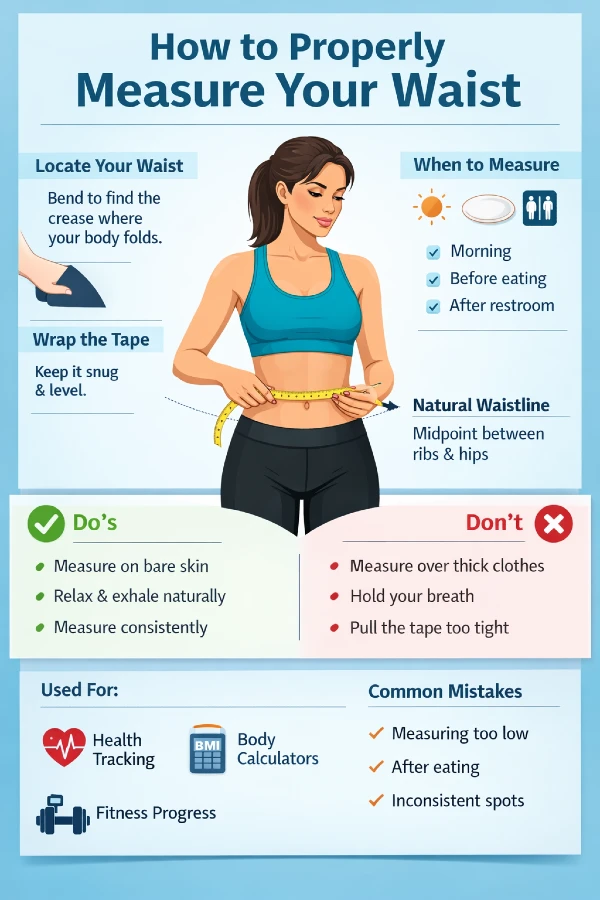
To measure your waist accurately, follow this method:
- Stand upright with feet shoulder-width apart
- Locate your natural waistline
- Wrap a flexible measuring tape around it
- Keep the tape flat and parallel to the floor
- Let it rest snugly without compressing the skin
- Exhale normally and note the measurement
This standardized method aligns with the approach used in medical settings and fitness assessments, ensuring your measurement works reliably with health calculators and tracking tools.
How Tight Should the Measuring Tape Be?
The tape should be snug but not tight.
It should touch the skin without digging in. If the tape leaves deep marks or feels uncomfortable, the reading will be lower than your true waist size. If it hangs loosely, the measurement will be inflated.
Accurate waist data is essential when it is later used alongside body mass values, BMI calculations, or calorie estimation tools.
Should You Measure Your Waist Over Clothes?
For best accuracy, measure directly on bare skin or over very thin clothing.
Measuring over thick clothes introduces error and reduces consistency. If clothing must be worn, use the same type each time so your measurements remain comparable—especially if you track progress over weeks or months.
Breathing and Posture During Measurement
You should never hold your breath or pull in your stomach when measuring your waist.
The correct measurement is taken while relaxed, after a natural exhale. Flexing your core or sucking in your stomach gives a false reading that does not reflect your true body size.
This is particularly important when waist measurements are used together with height measurements, which already have their own accuracy considerations.
Best Time of Day to Measure Your Waist
The best time to measure your waist is in the morning, before eating or drinking.
Throughout the day, waist size can fluctuate due to digestion, hydration, sodium intake, and bloating. Morning measurements provide the most stable baseline and work best when entered into health calculators or tracking logs.
Consistency in timing matters more than the exact number.
Why Waist Measurement Is Important for Health
Waist measurement is closely linked to abdominal fat, which is associated with metabolic health risks.
Healthcare professionals often consider waist size alongside body mass, height, and age to assess overall health. This is why many calculators use waist input to estimate risk factors more accurately than weight alone.
If you are already tracking body mass or using tools that estimate ideal weight, adding waist measurement improves accuracy and context.
Waist Measurement vs Body Weight
Body weight tells you how heavy you are. Waist measurement tells you where that weight is concentrated.
Two people with the same body weight can have very different waist sizes and very different health profiles. One may carry more fat centrally, while the other has more lean mass distributed elsewhere.
That is why waist size is often a better indicator of change than scale weight alone.
Common Mistakes When Measuring Waist Size
Some of the most common mistakes include:
- Measuring at different locations each time
- Measuring after meals
- Pulling the tape too tight
- Slouching or altering posture
- Confusing waist measurement with hip measurement
Avoiding these errors ensures your waist data remains reliable for long-term tracking and calculator use.
How Often Should You Measure Your Waist?
Daily measurement is unnecessary and often misleading.
For most people, measuring once every two to four weeks is enough to detect real changes. Short-term fluctuations usually reflect water retention or digestion rather than actual fat change.
This approach aligns well with tracking methods used alongside body mass trends rather than daily scale readings.
Can Waist Size Change Without Weight Change?
Yes. Waist size can decrease even when body weight stays the same.
Fat loss around the abdomen, muscle gain elsewhere, or posture improvements can all change waist measurement without affecting scale weight. This is why waist measurement is frequently used alongside body mass rather than instead of it.
Final Takeaway
To properly measure your waist, locate your natural waistline, keep the measuring tape level and snug, stay relaxed, and measure consistently at the same time of day. Waist measurement adds essential context to body mass, weight, and height data and improves the accuracy of health calculators and progress tracking.
How to Properly Measure Your Waist – People Also Ask (PAA)
How do you properly measure your waist?
To properly measure your waist, stand upright and relaxed, then place a measuring tape around your waist at the midpoint between the bottom of your ribs and the top of your hip bones. The tape should be snug but not tight, and you should measure after exhaling normally. Avoid pulling the tape too tight or measuring over thick clothing.
Where exactly is the waist measured?
The waist is measured at the narrowest part of the torso, usually located just above the belly button and below the rib cage. If the narrowest point is not clear, measure midway between the lowest rib and the top of the hip bone for accuracy.
Should you measure your waist in the morning or evening?
The best time to measure your waist is in the morning, before eating or drinking. Waist size can increase slightly throughout the day due to food intake, hydration, and bloating, so morning measurements provide more consistent results.
How tight should a tape measure be for waist measurement?
The tape measure should lie flat against the skin without compressing it. You should be able to slide one finger comfortably between your body and the tape. Measuring too tightly can give a smaller, inaccurate waist size.
Can waist size change without weight change?
Yes, waist size can change even if body weight stays the same. Fat loss around the abdomen, muscle gain, posture changes, or water retention can all affect waist circumference without noticeable weight changes.
Is waist measurement more important than weight?
Waist measurement is often more important than weight alone because it reflects abdominal fat distribution. Excess fat around the waist is more closely linked to health risks than total body weight.
Summary
Proper waist measurement involves placing a tape measure around the natural waistline, standing relaxed, and measuring after exhaling. Waist size helps assess abdominal fat and is often more important than body weight alone.
How to Measure Your Waist – FAQs
-
What is the correct way to measure your waist at home?
The correct way is to use a flexible tape measure, stand straight, relax your stomach, and measure at the natural waistline after exhaling. Repeat the measurement once or twice to ensure accuracy.
-
Do I need to measure my waist without clothes?
For the most accurate result, waist measurements should be taken directly on the skin or over very thin clothing. Thick clothing can add extra centimeters or inches and reduce accuracy.
-
How often should you measure your waist?
Measuring your waist once every one to two weeks is sufficient for tracking progress. Measuring too frequently can show normal daily fluctuations rather than real changes.
-
Does posture affect waist measurement?
Yes. Slouching, sucking in the stomach, or arching the back can all affect the measurement. Always stand straight, relaxed, and breathe normally for consistent results.
-
Is waist size different for men and women?
Yes. Men and women store fat differently, and waist measurement interpretation can vary by gender. However, the measuring method itself remains the same for both.
-
Why do health calculators use waist measurements?
Health calculators use waist measurements because they help estimate abdominal fat, which is closely linked to metabolic and cardiovascular health. Waist data improves accuracy when combined with height, weight, or body mass.
-
Can I use waist measurement to track fat loss?
Yes. Waist measurement is one of the most reliable ways to track fat loss, especially around the abdomen, even when the scale does not change significantly.